
Astrology of the Deep: Lilith, Nessus and Sedna, the Music of the Sky
- Gulsah Meza

- Aug 4, 2025
- 4 min read
Take a deep breath and let yourself drift into this moment. Feel the weight of your body, the texture of the fabric beneath your fingers, the stillness of the air around you. Close your eyes and let the sounds of the world fade away, until you hear only a distant hum. A silence that is not empty, but full of the promise of the universe, where astrology and music coexist in harmony.
The immense starry vault, with its infinite darkness and diamond dust, has always been an invitation to listen for humans. The Ancients, far from perceiving the cosmos as a silent place, heard the planets dancing to a secret music, a mathematical and celestial symphony that Plato and Pythagoras called the Music of the Spheres . They believed that each star, through its perfect movement, emitted a vibration, a pure note, and that all these notes formed a divine harmony. This music, which the physical ear cannot hear, once resonated in the depths of our souls and offered us a feeling of order and peace, a gentle caress of the universe on our own existence.
It was a comforting melody, a cosmic lullaby that whispered to us that everything had a place and a meaning. But today's astrologers know that the universe doesn't just sing a sweet lullaby. Far beyond the planets our ancestors knew, there are celestial bodies that vibrate at deeper, more complex frequencies, urging us to listen to the shadows of our own souls.
Their notes are far from perfect harmony. They are sounds that tear us from stillness and force us to feel. The first of these notes is that of Lilith . In the celestial symphony, Lilith is the wild, untamed melody, a raw and sensual note that refuses to be domesticated. She is not a negative dissonance, but a liberating counterpoint to the rigidity of the established order. Her sound is a call from the body, a melody that vibrates with rebellion and sovereignty. To listen to her is to allow yourself to vibrate that part of yourself that has been silent, to sing your own truth, without any concession. It is the music of emancipation, a song that liberates the voice and the body.

Then, if you dare to venture even further, there is the music of Nessus . The orbit of this asteroid is a chaotic dance, a solitary journey through a bitterly cold void, where sunlight is a distant promise. The sound of Nessus is a dissonance that hurts, a piercing vibration that echoes old wounds, betrayals, and patterns of abuse. It is a sound that forces us to feel, like the touch of an ice blade on a forgotten wound, in order to breathe new life into it. Listening to Nessus is opening ourselves to the source of our poison in order to better transmute it; it is a song of necessary and demanding confrontation, which pushes us to release what we still carry.

Finally, there is the most distant and profound note, that of Sedna . If Nessus travels in the cold, Sedna inhabits a silence that is the quintessence of emptiness. Her orbit is a dance of solitude lasting more than 11,000 years, a journey into an icy immensity where the sun is but one star among others. The contact of this space is that of an absolute cold that numbs everything, a total blackness where sensations dissolve into nothingness. The sound of Sedna is not a dissonance, it is an ethereal melody, almost imperceptible, which carries within it the memory of ancestral traumas and fundamental abandonments. Her song is the echo of a sorrow that does not belong to us, a vibration so deep that it seems to come from our bones, a wound that has become so ancient that it no longer hurts, but echoes in our inner silence.
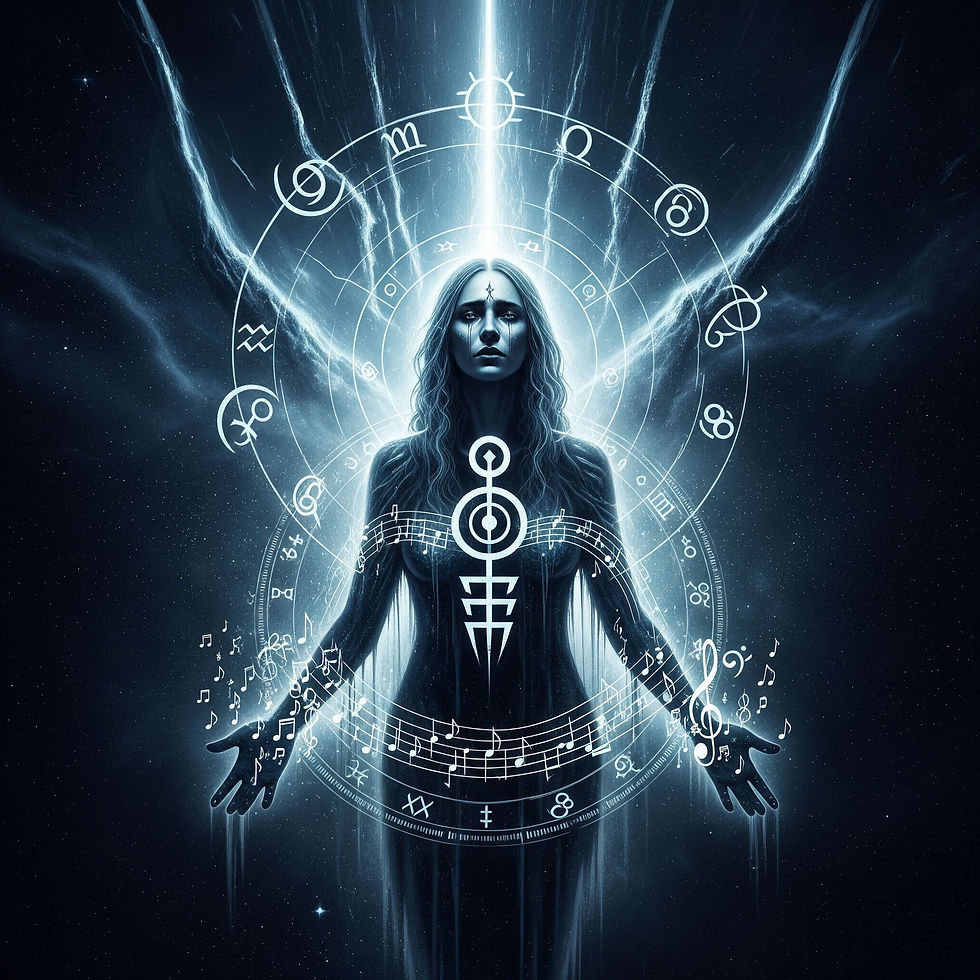
These notes cannot be played by a classical instrument. They require a tool that captures the invisible and translates touch without contact. This is why I immersed myself in the Theremin . This instrument, whose surface we never touch to make a sound, produces sounds from elsewhere, simply by the proximity of our hands, our bodies. The Theremin is a bridge between sound and silence, a way to capture the frequencies of these celestial bodies without having to constrain them. It is the perfect voice for the wild melody of Lilith, the piercing vibration of Nessus, and the ethereal song of Sedna. It shows us that the power to hear, to play, and to heal is within us, simply by opening ourselves to an invisible presence, by setting an intention, by offering a part of ourselves to the void to receive a gift.
Let yourself be carried again. Feel the warmth return to your fingers, the sound of life gently returning around you. Listen now, not with your ears, but with your soul. What is the melody of your Lilith, your Nessus, your Sedna? What stories do they tell you, and what music are you willing to make of them to release and honor what you carry?


Comments